Bunpei Kado Solo Exhibition “The volume of memories”
Ended
Friday12 September - Saturday25 October 2025
Art Front Gallery is pleased to present "The Volume of Memory," a solo exhibition by Bunpei Kado, an artist whose work continues to attract growing attention both in Japan and abroad. The exhibition will be held from September 12 (Fri) to October 25, 2025 (Sat).
Since his first solo exhibition at Art Front Gallery in 2012, Kado has steadily expanded his practice through numerous exhibitions, including participation in the Setouchi Triennale. His work has also received international recognition, including window display commissions for Hermès stores in Ginza, Kyoto, and Milan. In May 2025, Kado held his first solo exhibition in South Korea, marking a significant step toward even greater international visibility.
Kado's works are known for their intricate structures and materiality, often imbued with a subtle sense of humor. Architectural historian and critic Taro Igarashi has described his work as "resembling a humorous fable," while architect and historian Terunobu Fujimori has noted, “There is always something charming, almost laughable, in Kado’s work... When I look at it this way, your work and my architecture seem somehow similar.”
(Quotes from “Bunpei Kado Housing”)
Since his first solo exhibition at Art Front Gallery in 2012, Kado has steadily expanded his practice through numerous exhibitions, including participation in the Setouchi Triennale. His work has also received international recognition, including window display commissions for Hermès stores in Ginza, Kyoto, and Milan. In May 2025, Kado held his first solo exhibition in South Korea, marking a significant step toward even greater international visibility.
Kado's works are known for their intricate structures and materiality, often imbued with a subtle sense of humor. Architectural historian and critic Taro Igarashi has described his work as "resembling a humorous fable," while architect and historian Terunobu Fujimori has noted, “There is always something charming, almost laughable, in Kado’s work... When I look at it this way, your work and my architecture seem somehow similar.”
(Quotes from “Bunpei Kado Housing”)
| Hours | Tue ~ Sat 11:00 - 17:00 |
| Closed | Sunday, Monday, and National holiday |
| Talk event | 12 September, 2025 (Fri) 18:30~ / Speakers: Hitoshi Nakano (Curator/Art Producer) ×Bunpei Kado (artist) × Fram Kitagawa (Chairman of Art Front Gallery) *Please make a reservation via the link below https://forms.gle/sNHZGNZQCSjBHCpR6 |
| Reception | 12 September, 2025 (Fri) 19:30~ |
| Special support | Yoshichu Mannequin Co., Ltd |
Exhibition Highlight
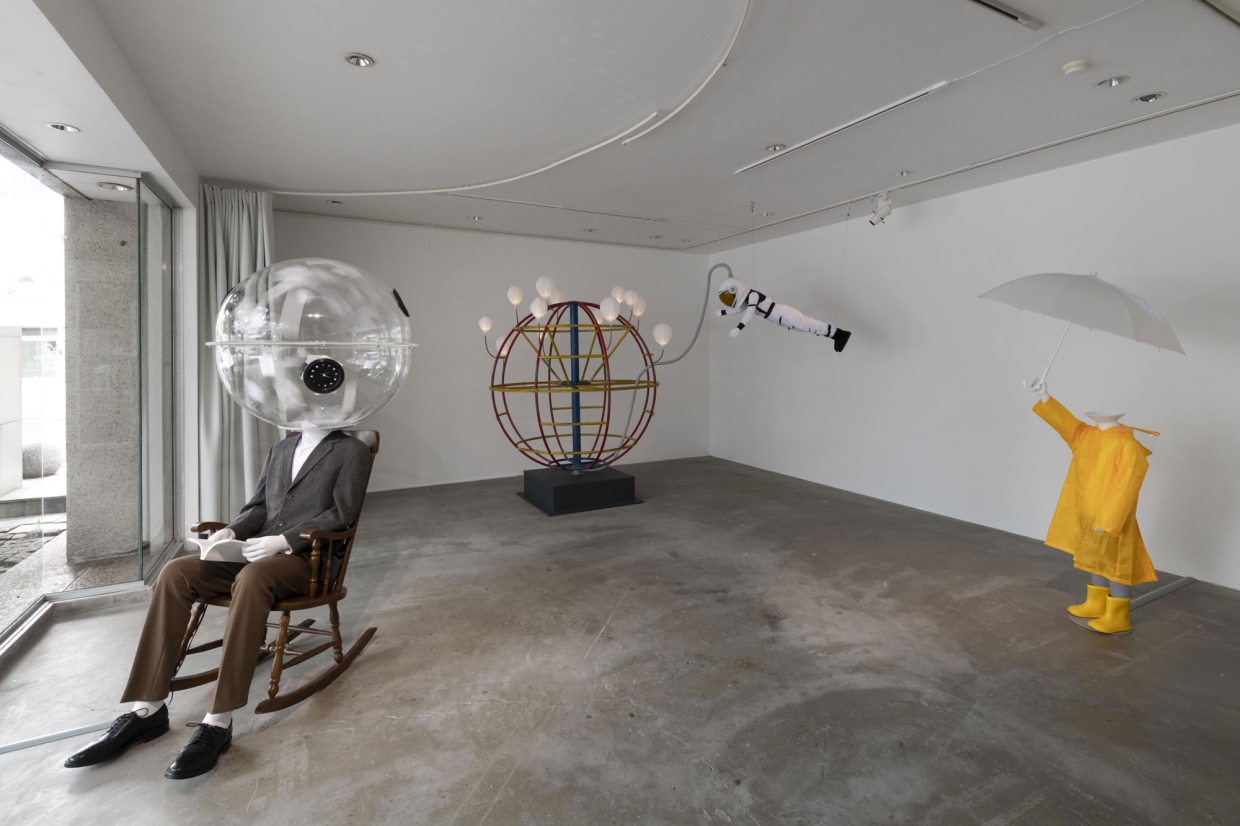
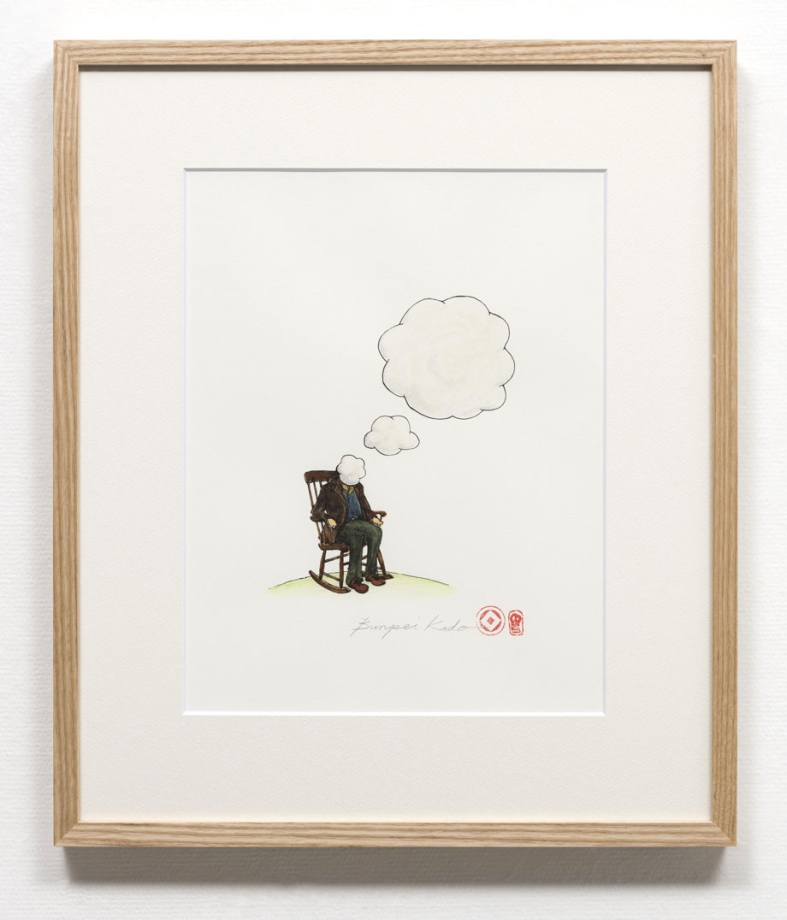
This exhibition focuses on Kado’s long-running “Memory” series, inspired by the ancient Japanese belief in "tsukumogami"—the idea that objects long in use come to possess a spirit. Through this lens, the exhibition explores memory embedded in objects and spaces through newly created installations.
Room 1: [Membrane of Memory] The installation Visualizing Human Memory
Human-shaped sculptures with balloon-like heads house intricate mechanisms within, evoking past experiences and memories. These installations symbolically represent the structure of memory and the inner world of individuals.
Room 2: [Memory of Wild] Expanding Memory to Land and Environment
While continuing the thematic line of the “Memory” series, this room introduces soil as a new material. By combining wooden antique tools with soil and plants, the works expand beyond individual memory to explore memories embedded in place and environment.
Kado’s works invite us to consider the passage of time within objects, the accumulation of memories in people and places, and how we perceive and relate to these invisible traces. We welcome you to experience this quiet yet profound dialogue between memory and materiality.
Room 1: [Membrane of Memory] The installation Visualizing Human Memory
Human-shaped sculptures with balloon-like heads house intricate mechanisms within, evoking past experiences and memories. These installations symbolically represent the structure of memory and the inner world of individuals.
Room 2: [Memory of Wild] Expanding Memory to Land and Environment
While continuing the thematic line of the “Memory” series, this room introduces soil as a new material. By combining wooden antique tools with soil and plants, the works expand beyond individual memory to explore memories embedded in place and environment.
Kado’s works invite us to consider the passage of time within objects, the accumulation of memories in people and places, and how we perceive and relate to these invisible traces. We welcome you to experience this quiet yet profound dialogue between memory and materiality.
Bunpei Kado: The Volumeof Memories
Hitoshi NakanoCurator / Art Producer
Associate Professor, Graduate School of Kyoto University of the Arts
Visiting Professor, Tohoku University of Art and Design
I’ve previously had the opportunity to work with Bunpei Kado on two of his exhibitions, first as part of The Poetry (the 2017 Kanagawa Arts Theatre), where Kado presented the works Sky Town and Space House, and then in 2022 for the group exhibition Dream/Land at the Kanagawa Kenmin Hall Gallery, for which Kado arranged four of his works into an installation titled Monkey Trail. On both occasions, I acted as the curator, and on both occasions, I sensed ideas in Kado’s work that seemed inspired by mathematics, physics and other scientific disciplines that study gravitation—fields that are often regarded as incompatible with art. Science is, in general, the pursuit of objective truth through evidence, while art (painting, music, dance, architecture, etc.) explores the ways in which people can connect and resonate within an endless ocean of subjective aesthetics and sensibility. Kado’s work introduces scientific concepts into the realm of art, mediated through myriad contexts and meanings, and intuitively reveals that the relationship between art and science need not at all be contradictory.
One thing his works always bring to my attention is the presence of earth’s gravitation. I become aware that everything on earth, from the houses we live in to the objects we take for granted, the stuff we never consciously notice, and, of course, the trees and plants growing in forests and on fields, all look uniformly pinned to the ground when viewed from above, kept here on earth by the force of gravity. I’m also reminded that we humans, too, can only really live and survive because we remain pulled to the ground. When I become aware of gravity in this way, I find myself wanting to view the whole world on a planetary scale, to see it all from the soil below my feet all the way up into space. In a sense, Kado’s works allow me to indulge in this desire. They capture the horizontal world spreading out before my eyes according to the laws of linear perspective, but also vertical space along the axis from ground to sky.
Now, I would like to propose the existence of the following three levels or dimensions in Kado’s work and his approach of horizontal and vertical space:
1) Earthscape – The ordinary everyday space in which we walk, build houses, and spend the entirety of our lives from birth to death; the world to which we are bound by gravitational force.
2) Middlescape (The In-between) – An intermediate, hovering state without relation to earth’s gravitational pull; perhaps not entirely unrelated to the Buddhist idea of bardo, the period of 49 days after death when the soul belongs neither to the world of the living nor the world of the dead.
3) Skyscape – A space made by humans, freely floating through the universe beyond gravity’s reach.
This exhibition includes an installation titled Membrane of Memory, composed of balloons and inflatable spheres filled with scraps of written text and images, firefly-like glowing lights, and other things. In this space, Kado’s memories intersect and communicate with memories of the audience. When we enter and experience Kado’s world, we become aware of our position (earthscape, middlescape, or skyscape) within the work he envisioned, and perhaps discover points of overlap between our individual “The volume of memories.”
It’s not difficult to imagine Bunpei Kado watching this unfold from somewhere nearby, a quiet, amused smile on his face. But first, we should go ahead and excitedly immerse ourselves in the world he has created.
One thing his works always bring to my attention is the presence of earth’s gravitation. I become aware that everything on earth, from the houses we live in to the objects we take for granted, the stuff we never consciously notice, and, of course, the trees and plants growing in forests and on fields, all look uniformly pinned to the ground when viewed from above, kept here on earth by the force of gravity. I’m also reminded that we humans, too, can only really live and survive because we remain pulled to the ground. When I become aware of gravity in this way, I find myself wanting to view the whole world on a planetary scale, to see it all from the soil below my feet all the way up into space. In a sense, Kado’s works allow me to indulge in this desire. They capture the horizontal world spreading out before my eyes according to the laws of linear perspective, but also vertical space along the axis from ground to sky.
Now, I would like to propose the existence of the following three levels or dimensions in Kado’s work and his approach of horizontal and vertical space:
1) Earthscape – The ordinary everyday space in which we walk, build houses, and spend the entirety of our lives from birth to death; the world to which we are bound by gravitational force.
2) Middlescape (The In-between) – An intermediate, hovering state without relation to earth’s gravitational pull; perhaps not entirely unrelated to the Buddhist idea of bardo, the period of 49 days after death when the soul belongs neither to the world of the living nor the world of the dead.
3) Skyscape – A space made by humans, freely floating through the universe beyond gravity’s reach.
This exhibition includes an installation titled Membrane of Memory, composed of balloons and inflatable spheres filled with scraps of written text and images, firefly-like glowing lights, and other things. In this space, Kado’s memories intersect and communicate with memories of the audience. When we enter and experience Kado’s world, we become aware of our position (earthscape, middlescape, or skyscape) within the work he envisioned, and perhaps discover points of overlap between our individual “The volume of memories.”
It’s not difficult to imagine Bunpei Kado watching this unfold from somewhere nearby, a quiet, amused smile on his face. But first, we should go ahead and excitedly immerse ourselves in the world he has created.
Artist Interviews
Featured Artists
Bunpei Kado
1978年福井県生まれ。武蔵野美術大学工芸工業デザイン学科金工専攻を卒業後、身近な日用品や既製品を素材に、詩的かつ幻想的なインスタレーションを制作している。既視感のあるオブジェクトを組み合わせ、光や空間の操作によって新たな意味を立ち上げることで、日常と非日常の境界を揺さぶる表現を展開。作品はしばしば「箱舟」や「庭」「家」といったモチーフを通じ、宇宙的なスケールと人間的な営みを接続させる試みとなっている。これまで「百年後芸術祭-内房総アートフェス」「瀬戸内国際芸術祭」をはじめ、韓国・台湾・シンガポールなど国内外で作品を発表。2020年にはSanwacompany Art Awardでグランプリを受賞。銀座・京都・ミラノのエルメス店舗におけるウィンドウディスプレイを手がけるなど、その表現は国内外で高く評価されている。主要な企業や公共施設にも作品が収蔵されている。