Iku Harada Solo Exhibition ‘In the Window’
Ended
Friday8 December 2023 - Sunday21 January 2024
Art Front Gallery is pleased to present a solo exhibition by Iku Harada. In recent years, Iku Harada has been expanding her activities in Japan and abroad through group exhibitions, solo shows and art fairs. Expect to see new works that also incorporate familiar landscapes.
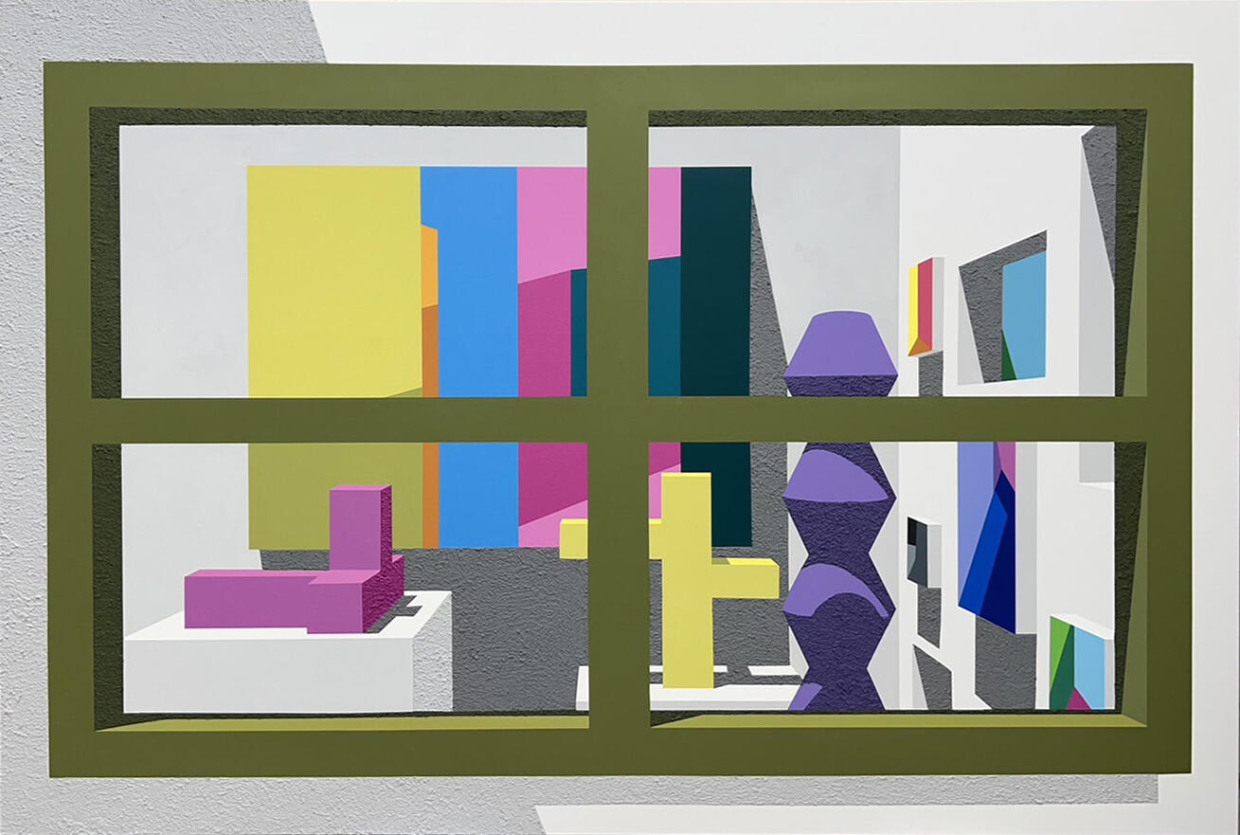
Art Front Gallery is pleased to present Iku Harada's first solo exhibition in five years. Iku Harada's unique concept is to create a 3D virtual world of her own creation, cut out scenes from that world and express them as 2D paintings. Harada reinterprets painting, which is historically compared to a 'window', as the PC display being our modern window, and has been active as a simulation painter since around 2009, attracting a lot of attention.
In recent years, when the world of virtual reality has become more accessible, we have come to understand the work she creates as a contemporary mode of expression that more clearly illustrates the interrelationship between the virtual and real worlds. Harada has continued to cut out fragments of her own virtual world without losing sight of her concept, and has repeatedly structured her exhibitions to present them in the form of paintings, sometimes in a rather immediate manner. At the same time, the world seen through the window of her paintings is a narrative expression that encompasses the artist's feelings and life stage at the time. When we look back at Harada's work to date as a single body of work, we can see it as a larger story that reveals who she is. Over the past five years, Iku Harada has exhibited on the international stage, first in Taiwan, then in Singapore and South Korea, and has grown considerably. At her recent solo exhibition in South Korea, for the first time she attempted a collaborative production, leaving the way she perceives the world in the hands of a third party. The result is a work that touches the depths of her psyche, where the paintings she draws have an expansive depth, and beyond that, multiple entrances to new virtual worlds are prepared for her. As a result, she reaffirms the way she sees her world. In this exhibition, as the title suggests, she shows her world depicted in the window as it has always been - as a short story (or as a landscape painting) or as a prose poem (or as an abstract painting). However, the way the work is seen is very different, with the painting as the window, and with an awareness of what lies beyond that window. Please take a look at the world Harada wants to convey through the window of each work.
In recent years, when the world of virtual reality has become more accessible, we have come to understand the work she creates as a contemporary mode of expression that more clearly illustrates the interrelationship between the virtual and real worlds. Harada has continued to cut out fragments of her own virtual world without losing sight of her concept, and has repeatedly structured her exhibitions to present them in the form of paintings, sometimes in a rather immediate manner. At the same time, the world seen through the window of her paintings is a narrative expression that encompasses the artist's feelings and life stage at the time. When we look back at Harada's work to date as a single body of work, we can see it as a larger story that reveals who she is. Over the past five years, Iku Harada has exhibited on the international stage, first in Taiwan, then in Singapore and South Korea, and has grown considerably. At her recent solo exhibition in South Korea, for the first time she attempted a collaborative production, leaving the way she perceives the world in the hands of a third party. The result is a work that touches the depths of her psyche, where the paintings she draws have an expansive depth, and beyond that, multiple entrances to new virtual worlds are prepared for her. As a result, she reaffirms the way she sees her world. In this exhibition, as the title suggests, she shows her world depicted in the window as it has always been - as a short story (or as a landscape painting) or as a prose poem (or as an abstract painting). However, the way the work is seen is very different, with the painting as the window, and with an awareness of what lies beyond that window. Please take a look at the world Harada wants to convey through the window of each work.
| Hours | Wed. - Fri. 12:00 - 19:00 / Sat. Sun. 11:00 - 17:00 |
| Closed | Mondays, Tuesday and Winter holidays (December 25th to January 5th) |
| Reception | Dec. 8 (Fri) , 18:00-20:00 |
| artist at the gallery | December 8 (Fri), December 9 (Sat) 14:00-17:00, December 10 (Sun) 14:00-17:00 and January 21 (Sun), 13:00-17:00 |
| トークイベント | 2024年1月12日 (金)19:00 - 20 :30頃を予定 / 畠中実 (NTTインターコミュニケーション・センター [ICC] 主任学芸員) x 原田郁 (作家) / 開催地: アートフロントギャラリー 2Fオフィス |
Exhibition Highlight
Iku Harada’s Paintings Transpose Virtual Worlds into Real Space.
Exhibition In the Window
Minoru HatanakaChief Curator, NTT InterCommunication Center [ICC]
Iku Harada generates virtual landscapes with 3D computer graphics, then transforms them into paintings. It may seem perverse. Today many artists use 3D CG, but not as a means to initiate paintings. She seems to be going the wrong way round, in a monumental detour. Is not the virtual world of 3D CG enough? Why does she shift this and make it into the central motif of her work? One answer has been proposed as relating to our post-Covid social conditions. I feel it is rather due to the simple fact that Harada is, above all, a painter.
Alberti likened a painting to a window onto the outside. We can also compare it to an entrance to virtual worlds (others have proposed painting as more like a curtain covering the window). If a painting is hung on a wall, it invites our gaze into the depths lying beyond, in a manner of a window. Paintings offer illusionistic extensions of the perspective lines of the real world, as they expand into alternative, imagined spaces.
This concept of a window now also relates to computer interface, which is similarly a mediation between zones. When we create windows, we open access points to another world. Windows let in outside air, allowing intercourse between inside and out. A landscape seen through a window is kind of vista borrowed by the interior. Windows are intersections across divided worlds.
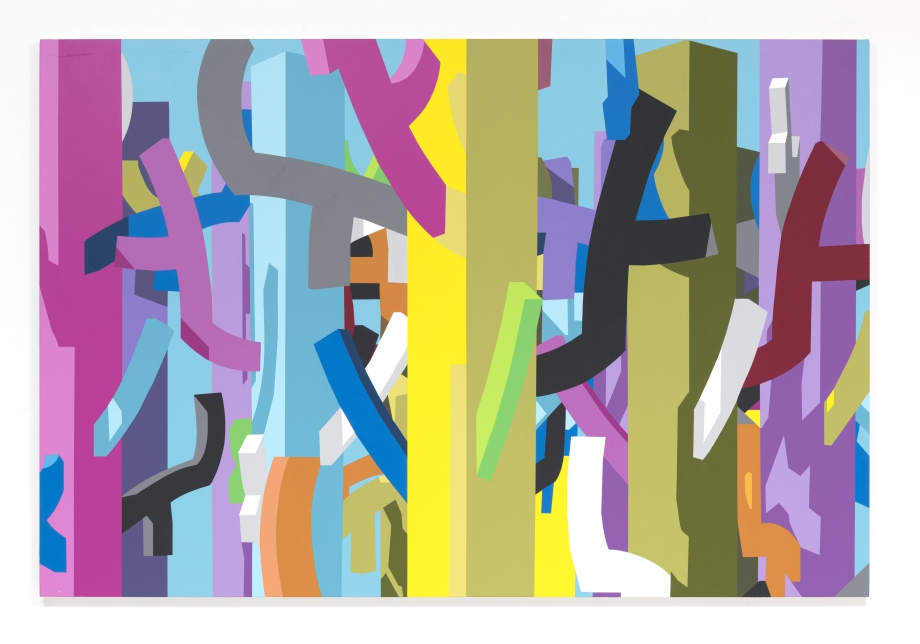
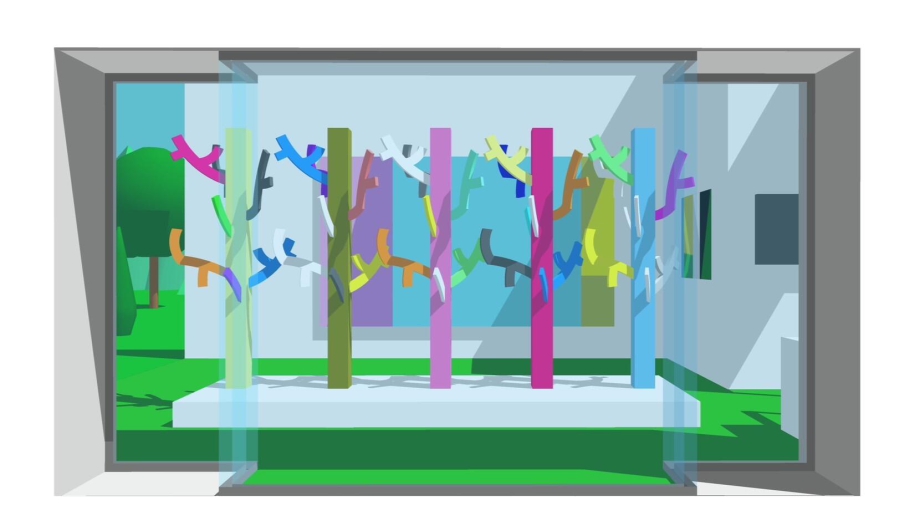
Harada’s experiment presented in this exhibition goes further by combining a pictorial space with the real space of the venue. Space as a painting motif is reconfigured physically, so that the exhibition room comes to be something seen through a window. The installation layers inside and out in multiple dimensions. It encourages us to move visually between them. The virtual space that Harada took as her painting motif, is now turned into an Albertian window. What the viewer encounters is a transposition of 3D CG into 2D representation. Harada builds 3D qualities pertaining to virtual space within our actual, physical space. She focuses on the illusory effect caused by these alternating dimensions. In the presence of virtual worlds made real, we find ourselves overcome by fantastical and confusing realms. 3D installations look like 2D tableaux.
As various spatial orders interpenetrate, space as a whole is turned into something profoundly illusory. Harada’s installation implies that the imagined spaces which Alberti said were through the painted ‘window’, also occur this side of it.
Alberti likened a painting to a window onto the outside. We can also compare it to an entrance to virtual worlds (others have proposed painting as more like a curtain covering the window). If a painting is hung on a wall, it invites our gaze into the depths lying beyond, in a manner of a window. Paintings offer illusionistic extensions of the perspective lines of the real world, as they expand into alternative, imagined spaces.
This concept of a window now also relates to computer interface, which is similarly a mediation between zones. When we create windows, we open access points to another world. Windows let in outside air, allowing intercourse between inside and out. A landscape seen through a window is kind of vista borrowed by the interior. Windows are intersections across divided worlds.
Harada’s experiment presented in this exhibition goes further by combining a pictorial space with the real space of the venue. Space as a painting motif is reconfigured physically, so that the exhibition room comes to be something seen through a window. The installation layers inside and out in multiple dimensions. It encourages us to move visually between them. The virtual space that Harada took as her painting motif, is now turned into an Albertian window. What the viewer encounters is a transposition of 3D CG into 2D representation. Harada builds 3D qualities pertaining to virtual space within our actual, physical space. She focuses on the illusory effect caused by these alternating dimensions. In the presence of virtual worlds made real, we find ourselves overcome by fantastical and confusing realms. 3D installations look like 2D tableaux.
As various spatial orders interpenetrate, space as a whole is turned into something profoundly illusory. Harada’s installation implies that the imagined spaces which Alberti said were through the painted ‘window’, also occur this side of it.
Featured Artists
Iku Harada
Iku Harada creates computerized virtual reality spaces, with houses and parks. She then depicts scenes from that world in paint. There are trees and even a gallery with paintings exhibited. Computerized scenes are not real, without depth of the atmosphere, and are deprived of ambivalent gradation of colors caused by different lights in the real world. These are classical paintings insofar as they show virtual-reality views, but they are first created by computer. Even in her virtual world, the sun rises and shadows move with the passage of time. Harada replaces her computer-generated virtual image with a painted canvas, existing in a real world. Recently her works encompass to three-dimensional block which are then to be drawn on the canvas again, thus creating the interlocking relationship between two- and three-dimensional world.